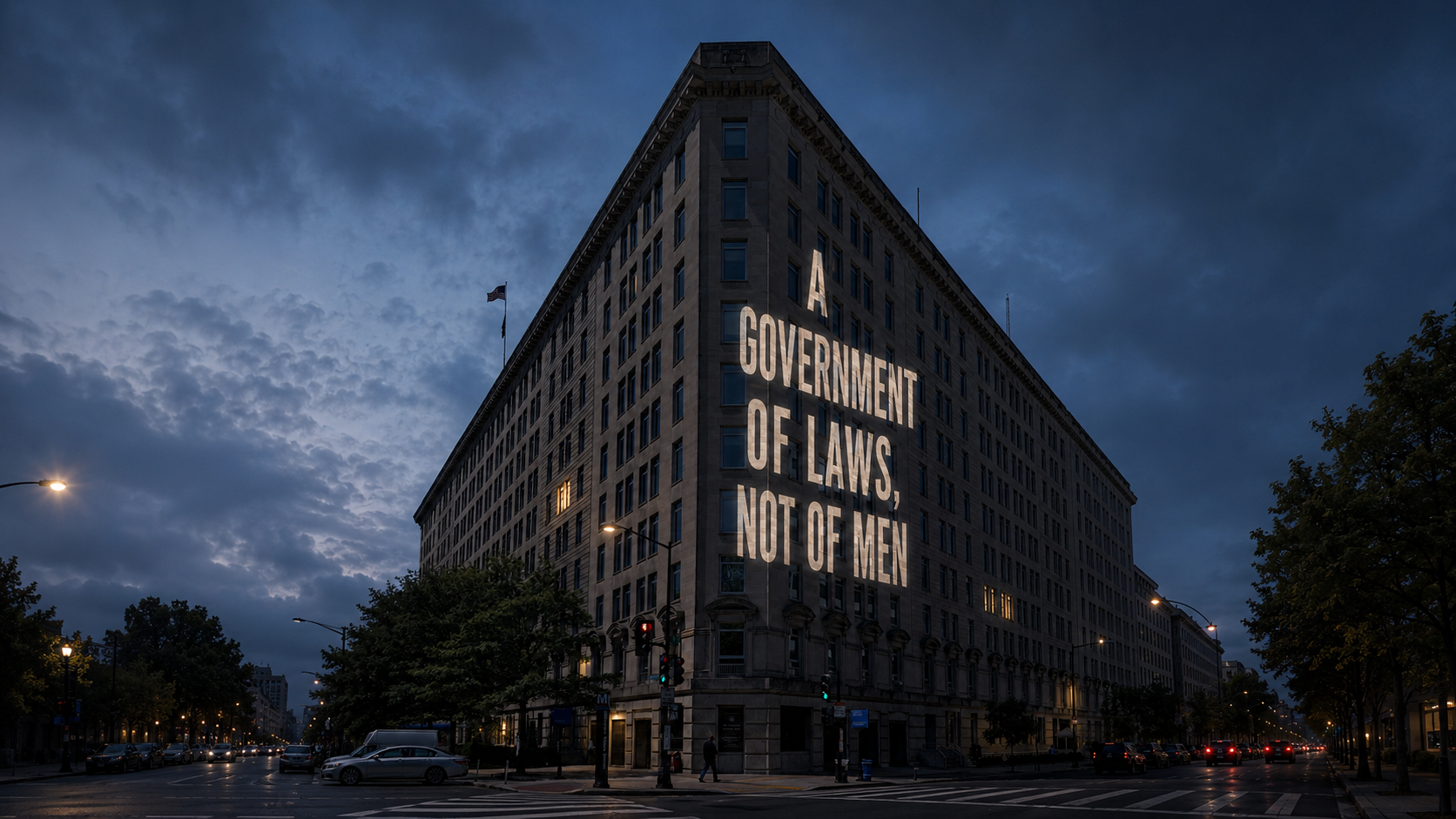
Earlier this week, former Department of Justice attorneys projected a single sentence onto the side of the DOJ building: “A government of laws, not of men.” The words come from John Adams. The principle is older than the country. And right now, leadership at the Department of Veterans Affairs is testing how much weight that principle still carries when VA collective bargaining rights are on the line.
In March, U.S. District Judge Melissa DuBose ruled that the Department of Veterans Affairs unlawfully stripped federal employees of bargaining rights and retaliated against unions for protected advocacy. She ordered VA to restore the status quo ante — including the Master Agreement, every supplemental agreement, and every memorandum of understanding (MOU). The First Circuit recently affirmed her injunction.
That should have ended the fight. Instead, VA Secretary Doug Collins and Acting Chairman of the Board of Veterans’ Appeals Ken Arnold — both attorneys who took oaths to uphold the Constitution — have spent the months since looking for ways around the order. What follows is a running list of the most brazen examples of ongoing noncompliance — items VA continues to refuse to address, where employees and their union are still bearing the cost. Together they show a pattern of contempt for VA collective bargaining rights that no amount of carefully worded press releases can paper over.
The court order behind the VA collective bargaining rights fight
Judge DuBose’s order was not advisory. It directed the Department to put union members and their representatives back in the position they would have occupied if the unlawful executive action against federal-sector bargaining had never happened. When VA’s compliance was challenged as cosmetic, Judge DuBose issued a follow-up clarification: compliance was required “in both form and substance.”
That clarification matters because every act of defiance below shares a common pattern. VA acknowledges the ruling in word, then quietly chips away at it in practice.
Five attacks on VA collective bargaining rights
1. Refusing to correct SF-50 bargaining unit codes
After the injunction, VA publicly claimed it had restored the Master Agreement. But the SF-50 personnel records that determine each employee’s bargaining unit status still showed the codes from the period when bargaining rights had been stripped. Without an accurate SF-50, an employee’s representation status is in limbo. Only after Judge DuBose’s “form and substance” order did the Department correct the codes — and only after the court was forced to spell out what “compliance” actually meant.
2. Refusing to fully restore negotiated telework rights
This is the largest of the active disputes. Telework was bargained for and codified in the Master Agreement. Judge DuBose’s order required restoration of the contract — and that includes the telework provisions. Secretary Collins continues to refuse full restoration. The Department’s posture treats a negotiated contractual right as something that can be partially honored when politically convenient and ignored when it is not. It is a direct attack on VA collective bargaining rights as they were actually negotiated.
3. Stalling the RA process and stripping accommodations from employees with disabilities
This goes beyond a labor dispute. Many of the VA employees who rely on telework or other accommodations are themselves veterans. Their medical conditions have not changed. Their job duties have not changed. What has changed is leadership’s willingness to enforce the accommodations that allow them to keep working — and the speed with which the agency’s reasonable accommodation (RA) process moves at all.
The RA process is supposed to be a structured, time-bound exchange between an employee, their supervisor, and a designated coordinator. Across the agency, that process is slowing to a crawl. Requests sit unanswered for weeks or months. Interim accommodations are being terminated without notice, without a documented reassessment, and without any meaningful response when employees and stewards try to escalate. In at least one situation reported to the union, a supervisor terminated an employee’s interim telework accommodation and then went silent — refusing to respond to emails at all, leaving the employee without a remedy and the steward without a counterpart to negotiate with.
That is not just a contract problem. Continuing to terminate or restrict longstanding telework and accommodation arrangements under these conditions raises serious concerns under the Rehabilitation Act, and turns a contract fight into a civil-rights problem.
4. Blocking attorney performance standards at the Board of Veterans’ Appeals
At the Board of Veterans’ Appeals, Acting Chairman Ken Arnold continues to refuse to restore the negotiated attorney performance standards Judge DuBose’s order requires. Performance standards govern how attorney work is evaluated, which directly affects discipline, ratings, and retention. Refusing to put the negotiated standards back in place keeps the Board operating outside the contract the court ordered restored — a textbook example of the kind of substantive noncompliance the follow-up order was meant to prevent.
5. Exploiting the FMCS arbitration blockage
The First Circuit affirmed Judge DuBose’s injunction but also held that ongoing labor disputes — exactly the ones above — should move through the normal grievance and arbitration process. At the same time, the Federal Mediation and Conciliation Service, which provides the arbitrator panels needed to move cases forward, is refusing to process arbitrator selections in VA matters. Employees are being told to take their disputes to arbitration while the machinery for getting an arbitrator is jammed shut. VA leadership is not the cause of the FMCS blockage, but it is content to benefit from it. Every day arbitration is unavailable is another day enforcement of VA collective bargaining rights slows down.
Why “form and substance” matters
A federal court order is not a press release VA gets to negotiate against. When Judge DuBose wrote “in both form and substance,” she was naming a tactic public officials use when they want the political cover of compliance without the discipline of it: announce the ruling has been honored, then walk back implementation piece by piece. That is what is happening with VA collective bargaining rights right now.
The pattern matters because the remedy depends on it. If “we restored the Master Agreement” can mean “we put the words back but kept ignoring the operational pieces — the telework provisions, the performance standards, the accommodation process, the path to arbitration” — then the order does not restore anything. It becomes a piece of paper VA references while doing the opposite.
A government of laws, not of men
Real leadership requires courage, especially when powerful people demand silence and obedience. Hurting thousands of employees, impairing the ability to serve veterans, ignoring federal court orders, and stripping rights to please political superiors is not strength. It is weakness disguised as authority.
Laws exist to hold up the values a society has agreed to share. They are how we keep the basic bargain — that obligations apply to everyone, that powerful people are not exempt, and that disagreements get worked out within the rules rather than around them. When public officials skirt those obligations, the cost is not borne by the union alone. It is borne by every employee whose rights are no longer reliable, every Veteran who depends on a stable workforce to deliver care and benefits, and every member of the public whose trust in the institution erodes a little further with every quiet act of noncompliance.
VA management officials do not have to agree with the current administration’s position on federal-sector unions in order to comply with a court order. By opting out of their collective-bargaining obligations anyway, they are hastening the Agency’s decline and turning their back on the society and the Veterans they are sworn to serve.
AFGE Local 17 will adapt, evolve, and fight wherever it can make an impact — through advocacy, litigation, negotiation, outreach to Members of Congress, public pressure, and strategic partnerships with those who still believe in the VA’s mission and the rule of law. The five brazen tactics above are not the end of the story. They are the current scoreboard in a longer fight over whether federal officials are bound by the same orders as everyone else — and whether VA collective bargaining rights mean anything at all when leadership decides they are inconvenient.
To Secretary Collins and Acting Chairman Arnold: behaving honorably requires that when a federal court issues an order, public officials comply with it in good faith — even when they disagree. We are a government of laws, and not of men. That principle still matters.
The projection that opened this article was the work of The Justice Connection. Their work is worth knowing.