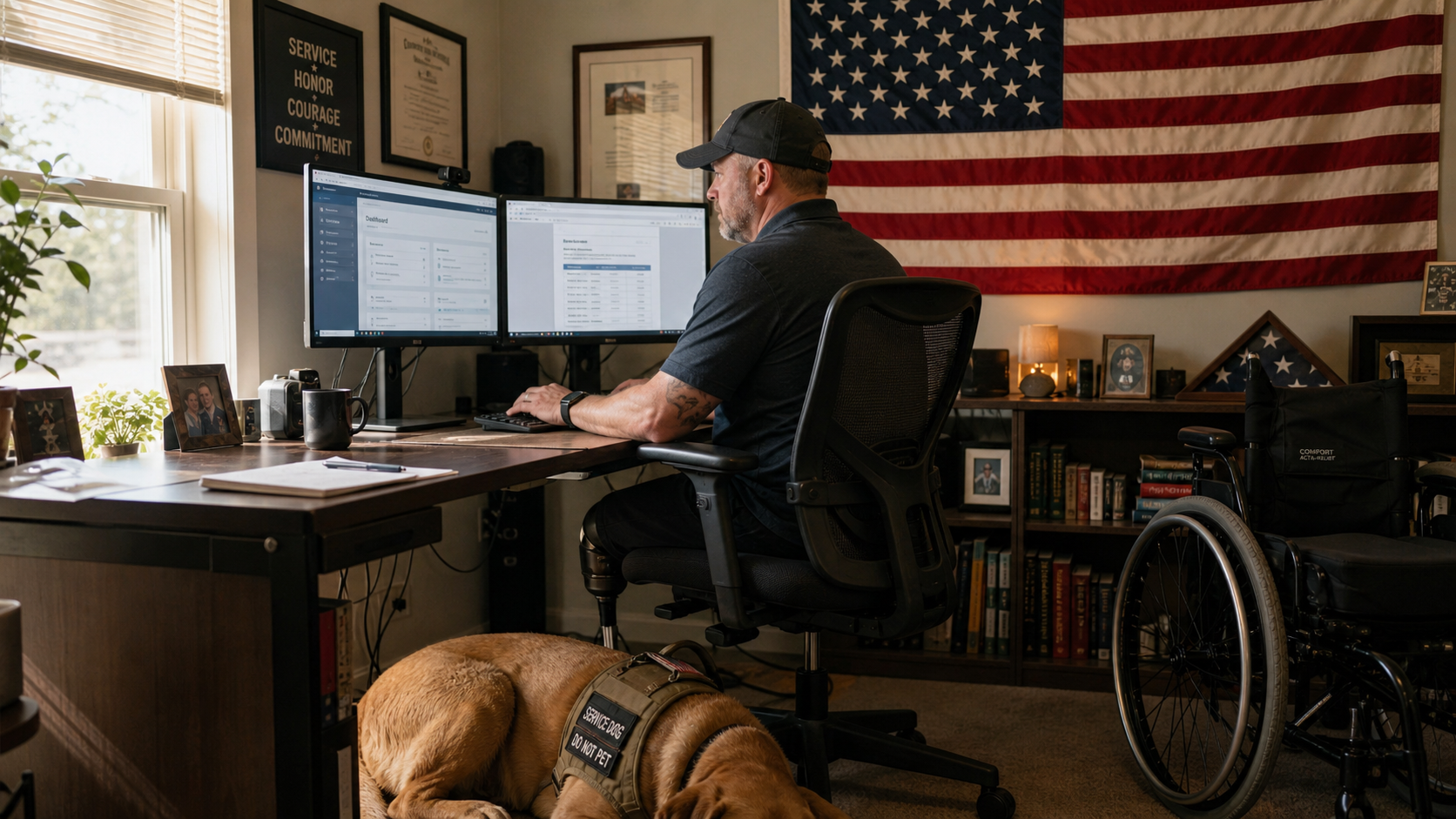
A disabled combat Veteran on our team at the VA recently bought a home and is expecting his first child. Years ago, he was hired with an approved full-time VA telework accommodation because of multiple service-connected disabilities. He has done his job remotely the entire time he has been here. Nothing changed — not his condition, not his duties, not his performance.
Then management sent him an email. Citing the Deputy Secretary’s return-to-office memo, they told him VA was reviewing all telework and remote-work accommodations and that he would have to rejustify his VA telework accommodation. So he did exactly what management asked. He reapplied.
They denied him.
Now this Veteran is being forced to commute two hours each way, burning through leave just to get through the workday. That is illegal. That is immoral. And it is not the VA we joined more than 25 years ago.
We are seeing this happen to disabled employees across the VA — and we want our members to understand exactly what the law requires, what management is doing wrong, and what to do if it happens to you.
What a VA Telework Accommodation Actually Requires Under the Law
Before we expose the tactics, we need to be clear about the legal framework. Too many disabled employees are being told things by management that simply are not true.
Under the Rehabilitation Act, telework is a lawful reasonable accommodation for many disabled employees. But there are a few important nuances every VA employee should understand.
You are not entitled to the accommodation of your choice. You are entitled to an effective accommodation. If a private office, modified equipment, or a different schedule will fully address the limitations of your disability, the Agency may legally choose that option over telework.
However, if your medical provider establishes that telework is the only effective accommodation — and you can still perform the essential functions of your job — then the Agency must provide it. The only way out for the Agency is to prove undue hardship, which is a very high legal bar.
Reasonable accommodation decisions must be individualized. Every request requires evidence-based analysis tied to the specific employee, the specific disability, and the specific position. Blanket policies and one-size-fits-all rules do not meet this standard.
That is the law. Now here is what we are seeing on the ground.
4 Illegal Tactics in the VA Telework Accommodation Crackdown
Tactic #1: Using Return-to-Office Memos to Override Approved Accommodations
Management is hiding behind the Deputy Secretary’s return-to-office memo to attack VA telework accommodation arrangements that were lawfully approved years ago. A general workplace policy does not override the Rehabilitation Act. An RTO memo cannot strip away an existing VA telework accommodation. The law does not work that way — and any attempt to use a workforce-wide directive as cover for stripping disability protections puts the Agency in legally indefensible territory.
When a federal statute and a Deputy Secretary memo conflict, the statute wins. Every time.
Tactic #2: Forcing Disabled Employees to Rejustify Already-Approved Accommodations
This is one of the most aggressive moves we are seeing. A VA telework accommodation that was approved years ago — based on legitimate medical documentation, supporting an employee who has performed successfully the entire time — is suddenly under review. The employee is told to “reapply” and “rejustify,” as if the original approval no longer exists.
That is not how reasonable accommodations work. Once a VA telework accommodation has been granted and the employee continues to need it, the Agency cannot simply demand a fresh round of justification because senior leadership changed its mind about telework. A change in workplace policy is not a change in the employee’s medical condition. The original approval remains valid unless the underlying facts change.
If you are being asked to rejustify your VA telework accommodation, comply on paper — but understand that the demand itself is legally suspect, and document everything.
Tactic #3: Substituting Bureaucratic Process for Individualized Analysis
Reasonable accommodation requires real, individualized, evidence-based decisions. What we are seeing instead is mass review — dozens of VA telework accommodation files run through the same checklist, with the same predetermined outcome.
That is not a lawful interactive process. It is a paperwork exercise designed to make denials look procedurally legitimate. Every disabled employee is entitled to a genuine, good-faith conversation about their specific limitations and the specific options available. When management substitutes a rubber-stamp review for that process, they are violating the Rehabilitation Act regardless of how many forms they generate.
If management never met with you, never asked questions about your specific situation, and never engaged with your medical documentation — that is a process failure that strengthens your case on appeal.
Tactic #4: Denying Telework Without Proving Undue Hardship
This is the critical legal failure. When a medical provider establishes that telework is the only effective accommodation, the Agency cannot simply say no. The Agency must demonstrate that providing telework would cause undue hardship — significant difficulty or expense in light of the Agency’s resources.
For an organization the size of the VA — with hundreds of thousands of employees, established remote-work infrastructure, and years of proven telework success — meeting that standard is extremely difficult. Yet denials are coming down with no real undue hardship analysis at all. Management is treating “we want people back in the office” as a legal justification.
It is not. Preference is not hardship. Discomfort with remote management is not hardship. The fact that other employees were called back to the office is not hardship. Undue hardship is a specific legal showing — and we are not seeing it made.
What to Do If Your VA Telework Accommodation Is Denied
If management denies your accommodation, the most important thing you can do is act fast. Procedural deadlines in this area are short and unforgiving.
Request Reconsideration Immediately
Do not let a denial sit. Submit a written request for reconsideration as soon as you receive the decision. Include any additional medical documentation that strengthens your case and reference the essential functions of your position that you can perform with telework. Be specific about why the denied accommodation is the only effective option for your situation.
Know Your 30-Day and 45-Day VA Telework Accommodation Deadlines
You generally have 30 calendar days to file a grievance after a final denial.
You generally have 45 calendar days from the date of the alleged discriminatory action to initiate an EEO complaint.
Miss these deadlines and you may lose the ability to challenge the denial entirely. Calendar them the moment you get the bad news. Do not wait to see if management changes its mind. Do not wait until you have “all the documentation perfect.” Start the clock-protective steps right away — you can always supplement with more evidence later.
Contact AFGE Local 17
We exist to fight for our members in exactly these situations. If you are facing a VA telework accommodation denial — or any reasonable accommodation issue — contact us at douglas.massey@afgelocal17.org. The sooner we are involved, the more options we have on the table.
VA Handbook 5975.1 is also a valuable resource for understanding how reasonable accommodation requests are supposed to be processed.
Why This Crackdown Matters Beyond Telework
This is not just about where people work. Secretary Collins knows exactly what this policy is doing. It is demoralizing the workforce. It is pushing experienced employees out the door. And it is weakening the VA’s ability to serve the Veterans we are supposed to be here for — setting the stage for privatization.
Disabled Veterans on our staff are being forced into impossible choices between their health, their paycheck, and their family. Many will leave because they cannot physically sustain a commute. Others will burn through their leave trying to comply. The Agency loses institutional knowledge. The Veterans who depend on us lose continuity of care. The mission suffers.
The Rehabilitation Act exists precisely to prevent this kind of outcome. The law still matters. And we intend to enforce it.
To our Local 17 members — thank you. You are the reason we are able to do this work. If a VA telework accommodation denial is affecting you or someone on your team, do not wait. Reach out today.